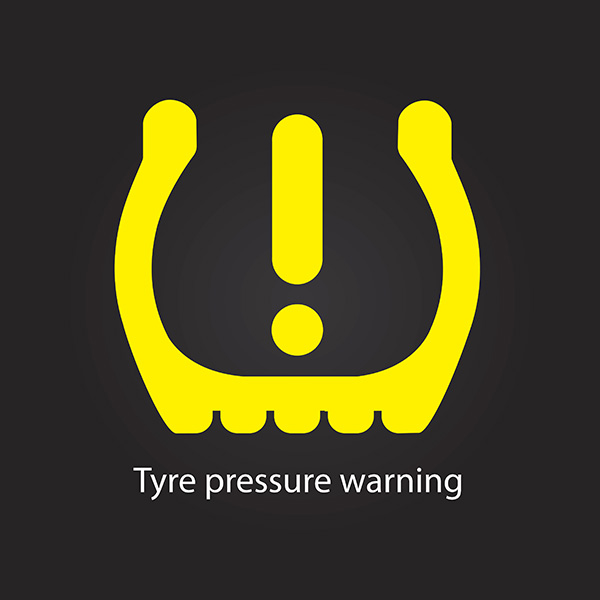
Every driver has a slightly different relationship with their dashboard. Some people treat warning lights like an absolute emergency, pulling over immediately, while others ignore them for weeks. But there is one specific light that tends to cause an awful lot of head-scratching. It looks like a little yellow horseshoe with ridges on the bottom and an exclamation point right in the middle.
If you are staring at this symbol right now, you aren't alone. That is your TPMS light.
At our shop, we see this light glowing on dozens of dashboards every single week. It is one of the most active warning systems in a modern vehicle. While it is designed to keep you safe, it can sometimes feel a bit like the boy who cried wolf, popping on during a cold morning only to disappear later in the day. Let us look at what your TPMS system actually does, why it illuminates, and how to handle it when it catches your eye.
What Exactly Is TPMS?
To understand the light, it helps to know the acronym. TPMS stands for Tire Pressure Monitoring System. It is an automated safety feature built into almost every vehicle manufactured after 2008.
The system relies on a tiny, battery-powered pressure sensor attached to the inside of each wheel, hidden right beneath the tire valve stem. These sensors constantly measure the exact amount of air inside your rubber. If the air pressure in any of your four tires drops below a specific safety threshold, usually around twenty-five percent below your vehicle's recommended setting, the sensor shoots a wireless signal to your car’s main computer, which triggers the dashboard light.
Solid Light vs. Flashing Light
When your TPMS light turns on, you need to observe its behavior closely during the first sixty seconds. The way the light acts tells us exactly what kind of problem we are dealing with.
A Solid, Steady Light: If the light pops on and stays lit like a solid yellow beacon, it means at least one of your tires is dangerously low on air. This is an immediate cue to safely pull into a gas station or a local shop to check your pressures with a handheld gauge.
A Flashing or Blinking Light: If the light flashes rapidly for about a minute when you first start your car and then settles into a solid glow, the system isn't reading low air. Instead, it means the TPMS system itself has suffered a malfunction. Usually, this means one of the wireless sensors inside a wheel has died or stopped communicating with the car's computer.
The Weather Drop
If your solid TPMS light suddenly turns on during the first crisp, cold morning of autumn, do not automatically assume you have a nail in your tire. Physics is usually the culprit here.
Air contracts when it gets cold. As a general rule of thumb, your tire pressure will drop by roughly one PSI for every ten-degree drop in outdoor temperature. If your tires were already sitting slightly low on a mild evening, a sharp dip in overnight temperature can shrink the air inside just enough to trip the sensor in the morning. Often, as you drive and the tires warm up from highway friction, the pressure expands back to normal, and the light shuts off. However, this is still a sign that your tires need a top-off of fresh air.
Why You Shouldn't Ignore the Warning
It is incredibly tempting to keep driving with a solid TPMS light, especially if the car feels like it is handling perfectly normal. But ignoring low tire pressure is a gamble that quietly drains your wallet and compromises your safety.
When a tire is low on air, more of the rubber's surface area physically slaps against the pavement. This creates massive amounts of internal friction and heat. Over time, that heat weakens the tire's internal structure, which can cause a sudden, catastrophic blowout at highway speeds. Additionally, under-inflated tires create more rolling resistance, forcing your engine to work harder and dragging down your fuel economy.
Let Us Take the Pressure Off
If your TPMS light is giving you a headache, you do not have to solve the mystery on your own. Our friendly team is here to help you sort it out in a matter of minutes. We will check your pressures with professional-grade gauges, inspect your tires for hidden punctures, and test your sensors to make sure they are communicating perfectly with your dashboard.
Is that mysterious horseshoe symbol currently lit up on your console? Stop by Taylormade Automotive in San Francisco, CA or book an appointment online today. We’ll get your tire pressures dialed in perfectly so you can drive with absolute confidence!
Frequently Asked Questions
Do TPMS sensors ever need to have their batteries replaced?
No, the batteries inside TPMS sensors are completely sealed within the molded plastic housing and cannot be changed individually. When a sensor battery dies, typically after five to ten years of use, the entire sensor assembly must be replaced and reprogrammed to your vehicle.
Why did my TPMS light stay on even after I added the correct amount of air?
Many newer vehicles require you to drive at a consistent speed, usually above twenty miles per hour, for at least ten to fifteen minutes before the computer resets and registers the new, corrected pressure readings. If it still won't turn off, the system may need a manual calibration reset.
Does my spare tire have a TPMS sensor inside it?
It depends entirely on your specific vehicle. Some larger SUVs and trucks feature a full-sized spare tire equipped with an active sensor that can trip the dashboard light if it goes low while sitting under the trunk. However, compact "donut" spare tires almost never include a TPMS sensor.